
State College Era
Norman Weisenfluh
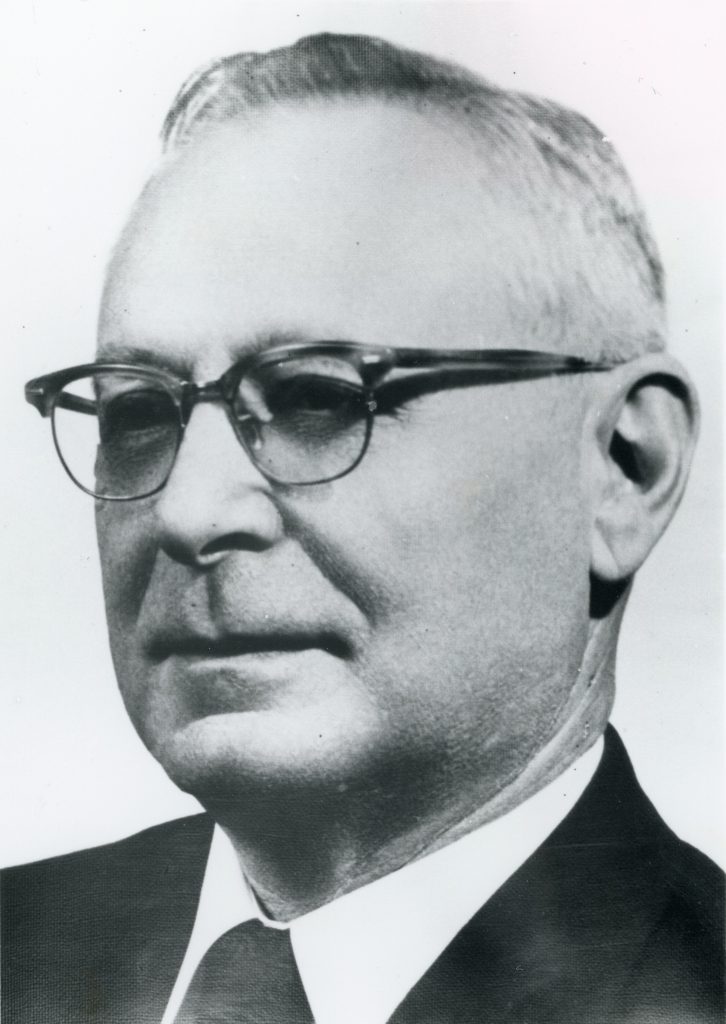
Dr. Norman N. Weisenfluh was a graduate of East Stroudsburg Normal School, Dickinson College (A. B.), University of Pennsylvania (M.A.), and the University of Pittsburgh (Ph.D.). Before his time here, Weisenfluh taught at places such as the Old Forge Public Schools and at East Stroudsburg State College. However, his connection to the college started long before his presidency as he previously served as a psychology and education professor, Director of the Laboratory School, Director of Placement, and Director of Student Personnel before then taking on the role of President. He was the President of Slippery Rock State College from 1956 until his retirement in 1964.
College Name Change
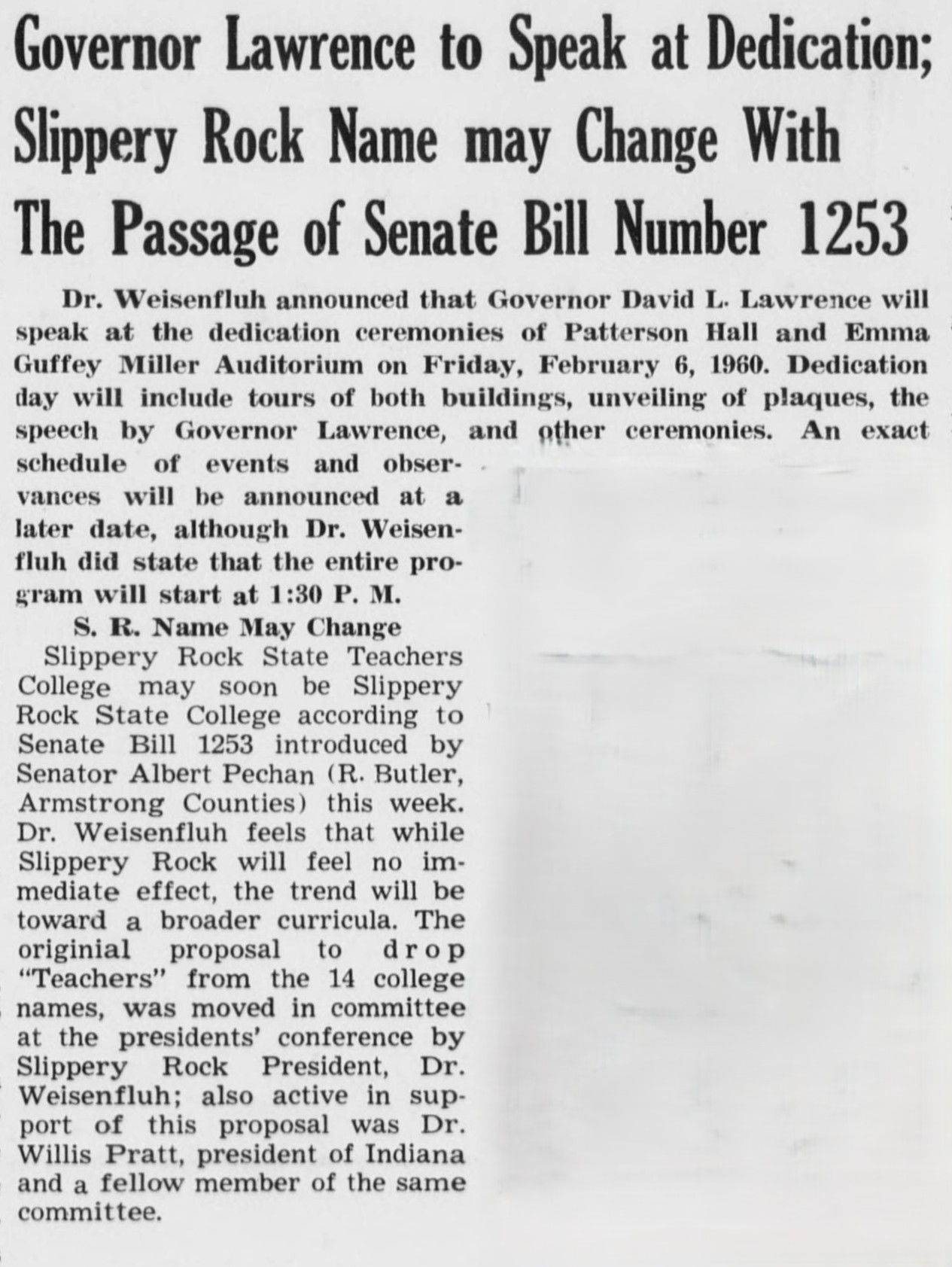
Weisenfluh was the president when the term “Teacher” was removed from the title of the school in January of 1960. Going from “Slippery Rock State Teachers College” to “Slippery Rock State College.” In a publication from the Pittsburgh Post Gazette from March 27th, 1961, Weisenfluh claims “We’ve been criticized for concentrating too much on method.” The article then goes on to talk about how there was controversy since over half of a student’s credits, at the time, revolved on how to teach but not the actual material itself. Weisenfluh was determined to resolve this questionable attribute and give students a better education by shifting the college’s focus to a more liberal education. With this change also came the introduction of other activities that come along with becoming a State College. One example of this was the start of fraternities, which Weisenfluh only allowed if they did not contain a racial barrier.
Campus Construction

During his time, he took on many different building projects including what was then known as Patterson Hall, the Field House, Rhoads Hall, an expansion on the Maltby Library, and the Emma Guffey Miller Auditorium. Additionally, due to his critical role in the advancement of Slippery Rock State College, a building built on campus was named in his honor, the Weisenfluh Dining Hall. All these buildings are still enjoyed by students, faculty, and locals in the area today.
Weisenfluh Dining Hall
Then vs. Now


Norman N. Weisenfluh Archival Collection
John Edwards
Exhibit Coming Soon!
Robert Carter
Exhibit Coming Soon!
Robert Carter created the departments of biological science and physical science, began a certificate program in earth and space science and expanded offerings in physics, geology and geography. During his tenure, master of arts and master of science degrees were added to the existing master of education program. While president, enrollment grew from 2,767 to 3,757 and the library grew from 58,000 volumes to 107,000. By spring of 1966, five buildings were under construction: a science building, a world cultures center, a women’s residence hall and two privately financed residence halls. Carter earned two degrees from Bucknell University and his doctorate from New York University.
Short biographical excerpt from “Principals and Presidents of Slippery Rock University.”
Robert Lowry
Exhibit Coming Soon!
Albert Watrel

President from 1968 to 1976, Albert Watrel was born in Brooklyn, New York and went to Syracuse University on a football scholarship. It was here where he earned his bachelor’s degree in bacteriology, master’s degree in education, and doctorate in biochemistry. He continued his academic career as a professor at the State University of New York-Cortland, at which he helped develop their Chemistry Department. After his time at Slippery Rock State Teachers College, he became the president of Dickinson State University in 1977.
Enrollment Skyrockets
In August of 1974, Watrel oversaw the largest freshman class in the history of Slippery Rock State College up until that point. There were 1,572 students to be enrolled, which brought their total expected enrollment up to 5,300 full-time students. This was unprecedented because as many other colleges in the area had declining enrollment, Slippery Rock State College’s just kept climbing.
Questionable Responses to Student Related Events/Publications
In a publication by The Rocket on December 12th, 1970, students slyly expressed their disapproval of the Vietnam War by publishing a wanted poster of President Richard M. Nixon on the front page. After this was published, along with many other criticisms of administrative policies that were expressed that semester, the Rocket was shut down. On the outside, the reason was stated as being due to the refusal of Co-Op to honor bills. However, many believed that they were shut down and unable to publish again until they met Watrel’s demands of a new advisor and editorial staff. Due to this, the Rocket refused and did not publish anything for over a year. By 1972, the shut-down of the Rocket and other issues such as healthcare and armed security police reached such an intensity that a demonstration was held. On Februrary 23rd, over 1000 students, a full fifth of the student body of the time, peacefully occupied Old Main demanding that Watrel hear their grievances. After much persuasion, Watrel had a discussion with the students at the Miller Auditorium. When he was informed that students were walking around sick due to poor healthcare he reportedly stated, “So what!” Then when approached with the general concerns over the educational climate he said, “Then go to Penn State.”


Additionally, there was an incident that occurred on the evening of April 19th, 1971, where some disturbances had been made between white and black students. There was a letter that was given to Watrel the next day asking for all charges to be dropped against black students, that extra police be removed from the vicinity of campus, that alleged harassment by white students be dealt with, and that no academic action be taken against any black students that are involved with negotiations on campus. Watrel only replied by saying “A college campus cannot and must not be a sanctuary in which a person is immune from civil responsibility for his acts.”


Termination of Watrel
In June of 1976, Watrel was fired by Governor Milton Shapp, effective immediately, and academic vice president Dr. James N. Roberts was named as acting president. Secretary of Education, John Pittinger, claimed that his department, and many others, had been investigating Watrel for a considerable amount of time. With this, he claimed that the only fix to a “deteriorating situation at Slippery Rock” was to terminate Watrel as president. Amongst many, some of the reasons for the immediate firing of Watrel were due to:
- Watrel removing Dr. Roberts from his office “arbitrarily and without reason” the prior Friday.
- Misuse of state funds at the college.
- Tried to provide inappropriate financial assistance to athletes.
- Attempted to coerce the editors and staff of the student newspaper to adopt a more favorable view of his administration.
With this event taking place, there was a considerable amount of division that occurred within the college community. However, in a mailgram, many members of faculty and community supported the termination of Watrel. This situation was so publicized that even Senator W. Thomas Andrews (R-21) called for a senate investigation into the termination of Watrel. Reported in the Butler Eagle on June 16th, 1976, he stated that this did not count as an endorsement but only a call for full elaboration on the reasons why he was fired.
James Roberts
Exhibit Coming Soon!
Lawrence Park
Full Exhibit Coming Soon!
During this period, a Master Planning Council was formed with the responsibility of making a “comprehensive study of plans and goals for the college.” Eight new programs were added during his first year, six leading to bachelor of science degrees in computer science, economics and business, music therapy, public administration, social welfare and rural and urban studies. In his second year, the college offered a bachelor of fine arts degree in art. Lawrence Park earned his bachelor’s degree from the State University of New York at New Paltz and his master’s and doctorate from New York University.
Short biographical excerpt from “Principals and Presidents of Slippery Rock University.”